§ 01Overview
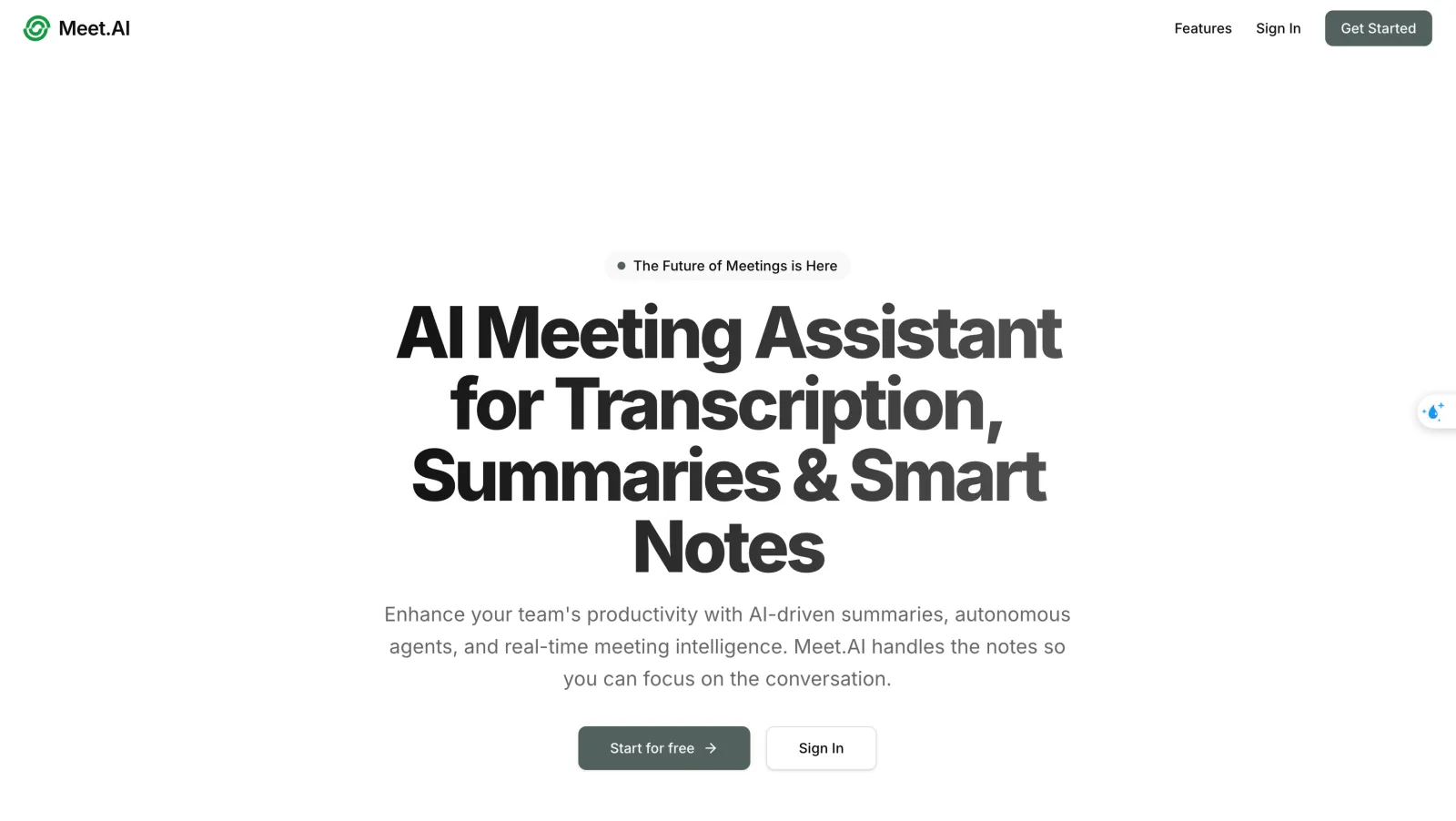
Meet.AI lets a user define AI agents with their own instructions, schedule meetings, and run video calls in which the agent takes part as a participant.
When the call ends, the recording and transcript are processed in the background into a markdown summary with timestamped notes. Afterwards the user can keep chatting with the agent, which answers with the meeting summary as context.
§ 02Problem & solution
Problem
Meeting notes are tedious and inconsistent, and context disappears once the call ends. Building a fix means coordinating real-time video, slow and bursty AI work, and paid tiers — without making the app feel slow.
Solution
Treat each call as a stream of events. Stream webhooks drive the meeting lifecycle, heavy AI work runs as retryable Inngest steps outside the request path, and every result lands back in Postgres where typed tRPC procedures serve it to the UI.
§ 03My role
Solo developer — design, full stack, deployment. What I personally implemented:
- 01Modelled users, agents and meetings in a Drizzle schema on Neon Postgres, with typed tRPC routers per module (agents, meetings, premium).
- 02Wired Stream webhooks into the meeting lifecycle: session start connects the agent through OpenAI Realtime; session end, transcription-ready and recording-ready events update the meeting.
- 03Built the Inngest pipeline that fetches the transcript, resolves each speaker to a user or an agent, and summarizes it with Gemini 2.5 Flash through Inngest Agent Kit.
- 04Implemented post-meeting chat: new messages trigger a background job that answers using the agent's instructions plus the stored summary.
- 05Set up Better Auth (email/password, Google, GitHub) and Polar subscriptions with free-tier limits of three agents and three meetings.
- 06Deployed on Vercel.
§ 04Architecture
- L1Client
- Next.js 16 App Router
- TanStack Query
- Stream Video & Chat SDK
typed queries & mutations - L2API
- tRPC routers
- Better Auth routes
- Webhook handler
events from webhooks & procedures - L3Async
- Inngest: meetings/processing
- Inngest: chat/message.new
model calls per step - L4AI
- Gemini 2.5 Flash · summaries
- OpenAI Realtime · in-call agent
results persisted - L5Data & services
- Neon Postgres + Drizzle
- Polar billing
- Stream
- Nothing slow happens inside a request: webhooks only record state and emit events.
- Each Inngest step (fetch → parse → add speakers → summarize → save) retries independently.
§ 05Technology stack
- Frontend
- Next.js 16ReactTypeScriptTailwind CSS 4Radix UInuqs
- API & auth
- tRPCTanStack QueryZodBetter Auth
- Data
- Neon (serverless Postgres)Drizzle ORM
- AI & jobs
- Gemini 2.5 FlashOpenAI Realtime (via Stream)Inngest + Agent Kit
- Platform
- Stream Video & ChatPolarVercel
§ 06Key features
- F01
Custom agents
Create agents with their own instructions and generated avatars.
- F02
AI in the call
The agent joins the video call as a participant through OpenAI Realtime.
- F03
Automatic summaries
Transcripts become markdown overviews with timestamped notes.
- F04
Recording & transcript
Each meeting keeps its recording and a searchable transcript.
- F05
Ask the meeting
Chat with the agent afterwards; it answers from the meeting summary.
- F06
Plans & limits
Free tier capped at three agents and three meetings; upgrades via Polar.
§ 07Engineering challenges
AI work that outlives a request
Problem
Fetching, parsing and summarizing a transcript can take far longer than a serverless request is allowed to run.
Approach
Webhooks only persist state and emit events. Inngest runs the pipeline as separate steps, so a failed model call retries without refetching the transcript.
Who said what
Problem
Transcript lines carry raw speaker IDs that can belong to either a human user or an AI agent.
Approach
Collect unique speaker IDs, query both the users and agents tables, and merge them before the transcript reaches the summarizer.
A call is a state machine
Problem
Session start, participant leave, session end, transcript ready and recording ready arrive as separate, asynchronous webhooks.
Approach
Map each event type to one meeting-status transition in a single handler, keeping the lifecycle explicit and easy to debug.
§ 08Screens
§ 09Links
- GitHub (opens in a new tab)github.com/tinhne/meetai
- Live demo (opens in a new tab)meetai-assistant.vercel.app